


SMM Panel Service Types Compared: HQ Followers, Standard, and Engagement Pods
Open the service list of almost any SMM panel and you will see the same follower or like product listed five, ten, sometimes twenty times. One version costs a fraction of a cent per unit. Another costs ten times more. A third is labeled "HQ," a fourth "real," a fifth "non-drop," and somewhere further down there is a service described as an "engagement pod" or "power likes."
For a new buyer, this looks like the same product sold at random prices. It isn't. These listings represent fundamentally different delivery models, with different sourcing, different delivery speeds, different drop rates, and different refill terms. Choosing between them is the single biggest decision you make when placing an order bigger than the quantity, and bigger than the panel itself.
This guide compares the three service types you will encounter most often: standard services, high-quality (HQ) services, and engagement pod services. It explains how each one works, what it costs and why, what retention you can realistically expect, and how to match each type to a specific goal. It also shows how MoreThanPanel organizes these differences into a simple color-coded quality tier system, so you can identify the right category at a glance.
Why One Service Comes in So Many Versions
Every SMM panel service is defined by three underlying variables. Once you understand them, the long service list stops looking random.
Sourcing — who performs the action. A follow, like, or view is executed by an account. That account might be an automated profile with no history, an aged account with posts and a profile photo, or a real person participating in an engagement exchange. The type of account performing the action is the most important factor in how long the result lasts.
Delivery method — how fast and in what pattern. Some services deliver thousands of units within minutes. Others deliver gradually over hours or days. Speed affects both how natural the growth looks and how aggressively platform integrity systems review it afterward.
Post-delivery terms — what happens after completion. Some services end their obligation the moment delivery completes. Others include a refill window that replaces drops for 30 days, 90 days, or longer.
Two services can deliver the same nominal product "1,000 Instagram followers" while differing on all three variables. That's why prices vary so widely and why the label alone tells you very little. For a step-by-step view of what happens to an order once you submit it, see how SMM panel orders are processed.
Standard Services: High Volume at the Lowest Cost
Standard services are the entry level of the SMM panel market. They are built to deliver large quantities quickly at the lowest possible price per unit.
How standard services are sourced
Standard services typically use automated accounts often called bot accounts that have minimal profile development. These accounts may lack profile photos, have few or no posts, and show little organic activity. Because they are inexpensive to create and operate at scale, providers can deliver large volumes at very low cost.
Delivery speed and pattern
Delivery is usually fast. Many standard services start within minutes and complete large orders in a short time window. This speed is the main appeal: if you need a high number quickly, standard services deliver it.
Retention and drop rate
The trade-off is retention. Accounts with minimal history are the easiest for platform integrity systems to identify and remove. As a widely observed industry pattern, standard services show the highest drop rates commonly in the range of 20–40% within the first week, and sometimes higher on poorly sourced services. Drops are concentrated in the first 72 hours after delivery. For a full breakdown of why this happens and how to measure it, see drop rate in SMM panels explained.
Refill terms
Standard services usually do not include a refill guarantee. Once delivery completes, the provider's obligation ends. If the count drops, the only option is a new paid order.
When standard services make sense
Standard services fit situations where volume and price matter more than permanence: testing how a service or panel performs, filling a short-term campaign requirement, or experimenting with delivery settings before committing budget to higher tiers. They are not a fit when you need a stable, lasting count on a brand account.
High-Quality (HQ) Services: Better Sourcing, Better Retention
HQ services sit above standard services in both price and retention. The term "HQ" is not standardized across the industry, so it's important to understand what it should mean in practice rather than relying on the label.
How HQ services are sourced
Genuine HQ services use accounts with more developed profiles: profile photos, post history, follower-to-following ratios that look plausible, and in some cases account age measured in months or years. Some HQ services also offer geographic targeting, delivering from accounts associated with a specific country or region.
Delivery speed and pattern
HQ services are usually slower than standard services. Higher-quality accounts are a scarcer resource, and providers often pace delivery to keep growth patterns more natural. A slower start time or completion time on an HQ service is normal, not a sign of a problem. If you need even more control over pacing, drip-feed delivery lets you split an order into scheduled runs — see drip-feed delivery in SMM panels for how quantity, runs, and interval work together.
Retention and drop rate
Because developed accounts are harder to distinguish from organic ones, they are removed less aggressively by platform sweeps. As an industry observation, mid-range HQ services commonly show drop rates of around 5–15% over 30 days, while top-end services using the most developed accounts commonly show around 2–8% over the same period. No HQ service eliminates drops completely what changes is the rate and the predictability.
Refill terms
HQ services frequently include a refill window, most commonly 30 days, with some premium services offering longer windows or lifetime refill. The refill window is what turns lower drop rates into a protected outcome: when drops do happen, the provider replaces them within the stated period. For exactly how refill windows, eligibility conditions, and voiding rules work, see SMM panel refill policy explained.
When HQ services make sense
HQ services fit brand accounts, client accounts managed by agencies, and any profile where a stable count matters more than the lowest price. They are also the safer choice when the account will be reviewed by partners, advertisers, or clients who will notice sudden count drops.
Engagement Pods: Reciprocal Engagement Between Real Users
Engagement pods work on a completely different model from standard and HQ services. They are not primarily about follower counts at all.
How engagement pods work
An engagement pod is a group of users who agree to engage with each other's content typically liking, commenting on, or saving each new post shortly after it is published. Pods historically formed in group chats on Telegram, Instagram direct messages, and similar channels. Some SMM panels and third-party services offer pod-style products, where your post is distributed to a network of participating accounts that engage with it within a short time after publishing.
What pods deliver — and what they don't
Pods deliver engagement on individual posts: likes, comments, and saves concentrated in the first period after publishing. They generally do not deliver followers in the way a follower service does. The core idea behind pods is that early engagement on a post can signal interest although no platform publishes the exact weight of early engagement in its ranking systems, so any claim about precise algorithmic effects should be treated as a hypothesis, not a confirmed rule.
Retention and quality characteristics
Because pod participants are typically active accounts, pod engagement is less exposed to the bulk account removals that cause follower drops. However, pod engagement has its own limitations. Comments are often generic ("Great post!", emoji-only replies), engagement comes from accounts outside your actual audience, and the engagement pattern the same accounts engaging with every post can be repetitive.
Platform policy considerations
Platforms treat coordinated engagement exchanges as a form of inauthentic engagement. Instagram's Community Guidelines, for example, prohibit artificially collecting likes, followers, or shares. Whether a specific pod arrangement is treated as a violation depends on the platform's enforcement, which is not publicly documented in detail. The practical takeaway: pods are not a "safer by default" option simply because real users are involved. For account-level safety practices that apply to every service type, see how to safely use an Instagram panel without getting shadowbanned.
When engagement pods make sense
Pods fit creators who post regularly and want engagement on individual posts rather than higher follower counts. They are less suitable for buyers who need a measurable count increase, predictable delivery quantities, or audience-relevant engagement.
Side-by-Side Comparison
The table below summarizes how the three service types differ across the variables that matter most when choosing.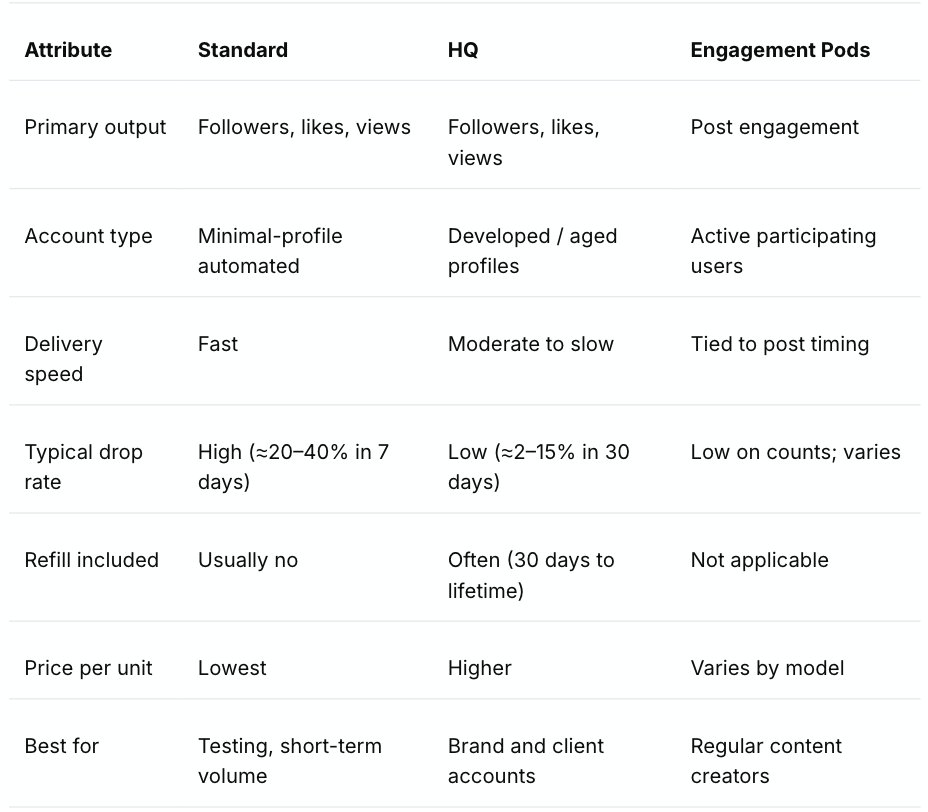
Drop rate ranges reflect commonly reported industry observations, not guaranteed outcomes. Your own results depend on platform, timing, and order size. The only reliable number for a specific service is the one you measure yourself.
How MoreThanPanel Organizes Service Quality: Basic, Medium, and Elite
Comparing services across sourcing, speed, retention, and refill terms takes time, especially when a panel lists hundreds of services. To simplify this, MoreThanPanel tags every service with a color-coded quality tier. Each tier maps directly to the service types described above, so you can identify the category of a service before reading its full description.
🟡 Basic Tier — High-Volume & Budget BOT Services
The Basic tier is built for maximum volume. It offers the most affordable BOT-generated engagement for high-volume testing and budget-conscious campaigns, with rapid delivery at the lowest rates. MoreThanPanel states clearly that occasional drops may occur in this tier and that refill guarantees are not included.
In the framework of this guide, Basic corresponds to standard services: fast, low-cost, volume-focused, with no post-delivery protection. It's the right tier for testing and short-term volume needs and the wrong tier when you need a count that holds.
🟢 Medium Tier — Balanced & Reliable Engagement
The Medium tier focuses on cost-efficient stability. These services are engineered for realistic engagement, offering a balanced mix of delivery speed, high retention, and system reliability. Selected Medium services include automatic refill guarantees.
Medium corresponds to the mid-range HQ category. The key detail is the word "selected": refill is included on some Medium services, not all. Before ordering, check the individual service description to confirm whether automatic refill applies to that specific service ID.
🔵 Elite Tier — Premium Non-Drop & Organic-Grade Services
The Elite tier is built for brands, agencies, and public figures. MoreThanPanel describes it as best-in-class services using organic-grade delivery methods, with 100% non-drop retention and lifetime refill protection.
Elite corresponds to the top-end HQ category. As explained in our drop rate guide, no provider controls platform enforcement, so "non-drop" in practice means the delivered count is protected any drops that platform sweeps cause are covered by the lifetime refill commitment. This combination of top-quality sourcing and indefinite refill coverage is what makes Elite the tier designed for accounts where count stability is a business requirement.
Choosing between the tiers
A simple way to use the tier system:
Choose Basic when you're testing a service, running a short-term campaign, or optimizing purely for volume and price.
Choose Medium when you want realistic engagement and good retention at a controlled cost and confirm refill availability on the specific service.
Choose Elite when the account represents a brand, a client, or a public figure, and a stable count protected by lifetime refill matters more than price per unit.
How to Choose the Right Service Type for Your Goal
The right service type depends less on budget and more on what the result needs to do. Start with the goal, then work backward to the service type.
If your goal is testing
Use the cheapest tier available, at the minimum order quantity. Your goal is to observe start time, delivery speed, and retention not to build a lasting count. Measure drops at 3, 7, and 14 days before scaling anything.
If your goal is a stable count on an account that matters
Use HQ services with a documented refill window. The extra cost per unit pays for lower drop rates and a replacement mechanism. Calculate cost per retained unit, not cost per delivered unit: a cheap service that loses 35% of its delivery is often more expensive per retained follower than an HQ service that loses 5%.
If your goal is engagement on individual posts
Consider engagement-focused services, including pod-style products, but understand their limits engagement quality, audience relevance, and platform policy risk. For many creators, pairing a smaller HQ follower order with consistent organic posting delivers more durable results than relying on pods alone.
If you manage client accounts
Default to the highest quality tier the client budget allows, document the refill terms for every order, and set reminders to check counts within the refill window. Client accounts are where unexpected drops cause the most damage to trust.
Whatever the goal, verify that the panel itself is legitimate before comparing service types. See how to avoid scams when buying services from an SMM panel for warning signs, and top features to look for in a reliable SMM panel for the wider evaluation checklist.
Common Mistakes When Comparing Service Types
Comparing price per delivered unit instead of price per retained unit. The cheapest listing is rarely the cheapest result. Always factor expected drop rate into the comparison.
Trusting labels without checking terms. "HQ," "real," and "non-drop" are not standardized terms. The service description, delivery account details, and refill policy matter more than the label. A clear tier system such as a color-coded quality tag helps, but you should still read the individual service terms.
Judging retention too early. Checking your count six hours after delivery tells you almost nothing. Most drops happen between 24 and 72 hours, with ongoing attrition after that.
Mixing service types on the same metric at the same time. Running a standard order and an HQ order for followers on the same account simultaneously makes it impossible to tell which one dropped and can void refill eligibility on many panels.
Misreading the order dashboard. A Completed status means delivery finished, not that the count is final. For what every status means, see SMM panel order statuses explained. For more errors buyers repeat, see common mistakes when using SMM panels.
Summary
SMM panel services differ across three variables: sourcing, delivery method, and post-delivery terms. Standard services deliver high volume quickly at the lowest price, with high drop rates and usually no refill. HQ services use developed accounts, deliver more slowly, retain far better, and often include refill windows. Engagement pods focus on post-level engagement through reciprocal participation rather than follower counts, with their own quality and policy limitations.
MoreThanPanel's Basic, Medium, and Elite tiers map directly onto this framework: Basic for volume and testing, Medium for balanced cost and retention with refill on selected services, and Elite for brand-grade stability backed by lifetime refill protection.
Choose by goal, compare by cost per retained unit, read the service terms behind every label, and measure your own results over at least two weeks. That approach will tell you more about any service than its name ever will. For the next step in evaluating a panel overall, see SMM panel selection factors.