


Fake Social Media Indicators: What the FTC Rule Covers
The FTC’s rule on fake social media indicators addresses fabricated influence used for commercial misrepresentation. It does not treat every paid promotion, follower increase, or disappointing campaign as the same conduct. For agencies, resellers, and business buyers, the important questions concern the indicator’s origin, each participant’s role, what they knew, and how the resulting influence is represented.
The relevant provision is Section 465.8 of the Rule on the Use of Consumer Reviews and Testimonials. The rule took effect on October 21, 2024, according to the FTC’s rule questions and answers.
This guide explains those distinctions through illustrative scenarios and practical review tools. It provides general information, not a legal determination about a particular transaction or provider. The examples are fictional, and the decision tools are editorial aids rather than lawyer-reviewed compliance assessments.
Identify which indicators the rule addresses
Read the definition of fake indicators
Start with the thing being supplied. The definitions in 16 CFR § 465.1 cover metrics the public uses to assess social media influence. Examples include followers, subscribers, views, plays, likes, saves, shares, and comments.
The definition of fake indicators includes activity generated through bots, invented individual accounts, accounts created using someone’s personal information without consent, or hijacked accounts. It also covers indicators that otherwise fail to reflect a real person’s or entity’s activity, opinion, findings, or experience.
An account photograph or completed profile therefore cannot settle authenticity. Neither can an order status showing that a requested number was delivered. Those observations describe appearance or fulfillment, not necessarily the origin of the indicator.
When reviewing a service, write down exactly what is promised. “Audience growth” might refer to advertising exposure, creator recommendations, delivered followers, or something else. Those descriptions need different evidence.
Useful starting questions include:
- What metric is expected to change, and on whose account?
- What activity creates the increase?
- Who performs that activity, and why?
- What does the supplier mean by terms such as “real” or “organic”?
- Which parts of the explanation are documented, and which remain unknown?
A vague answer is an information gap. It is not, by itself, proof of a violation, but it should not be recorded as proof of authenticity either.
Separate authentic promotion from fabricated influence
Payment alone does not answer whether an indicator is fake. The FTC’s guidance distinguishes real people choosing to follow a business after a creator’s recommendation from fabricated indicators. That distinction makes the underlying activity more useful than the campaign’s marketing label.
Illustrative scenario: an authentic creator referral. A small business pays a cooking creator to demonstrate a product and invite interested viewers to visit its profile. Some viewers independently choose to follow. The campaign records identify the creator, content, payment, and referral period. The business reports the partnership and observed results without claiming that every new follower purchased the product.
The voluntary followers in this example differ from fabricated accounts. Separate advertising and endorsement requirements still need attention. The FTC’s influencer disclosure guidance explains that material brand relationships should be made clear to the audience.
Illustrative scenario: fabricated influence in a sponsor pitch. An agency knowingly obtains invented followers for a client’s profile. It then places the inflated audience figure in a sponsorship proposal as evidence of genuine popularity. Its files include the supplier’s description of the fabricated accounts and the agency’s instruction to present the increase as authentic growth.
That combination raises the specific fake-indicator and commercial-misrepresentation questions addressed by this rule. Calling the purchase “promotion” does not change the documented facts. A qualified reviewer would examine the full transaction rather than treating either scenario as a universal legal template.
Illustrative scenario: evidence remains incomplete. A reseller describes a package as creator promotion but supplies no creator names, campaign content, or explanation of how users encounter the promoted account. The buyer receives a count increase and an invoice. Neither document answers whether the followers resulted from voluntary interest or another mechanism.
The appropriate internal finding is that the origin has not been established. Ask for the missing method information, preserve the original description, and avoid presenting the increase as verified audience approval. Do not invent a legal conclusion from the absence of records alone.
If the supplier later identifies an actual referral campaign, evaluate that explanation against available content and dates. If it instead acknowledges fabricated accounts, update the factual record and escalate the proposed use of those indicators. New information should change the assessment; it should not disappear into a support conversation that the reporting team never sees.
Distinguish seller and buyer exposure
Distribution and procurement have different rule language
Section 465.8 contains separate provisions for supply and acquisition. Both include a knowledge standard, but their treatment of commercial misrepresentation is worded differently.
For sellers and distributors, the provision addresses fake indicators they knew or should have known were fake and that can be used to materially misrepresent influence or importance for a commercial purpose.
For buyers and those procuring indicators, it addresses fake indicators they knew or should have known were fake and that materially misrepresent their influence or importance for a commercial purpose.
Preserve that distinction when evaluating a transaction. Do not rewrite both provisions as “only the final customer matters” or assume that supplying an intermediary removes the supplier from consideration.
Map the actual roles before reaching a conclusion:
- A supplier may create or source the activity.
- A reseller may distribute it under a different service description.
- An agency may procure it for a campaign or arrange its delivery.
- A business may use the resulting figures in promotional materials.
One organization can perform several roles. A reseller label does not describe everything that organization does, and a purchasing contract does not explain every later representation.
The definition of distribution concerns providing indicators to people or businesses who could use them to misrepresent their influence. The FTC’s guidance also distinguishes this from merely hiring an influencer who happens to have fake followers. That example should not be expanded into immunity for every influencer arrangement.
Knowledge and commercial purpose require careful reading
The words “knew or should have known” make context important. A supplier’s reassurance should be considered alongside the description, correspondence, delivery method, and other available facts.
The FTC’s questions and answers discuss a business deceived by a promotional supplier. They explain that warning signs can matter when assessing whether the business should have recognized fake followers. Simply asserting ignorance does not resolve every case.
Create a dated timeline: what was promised before approval, what became apparent during delivery, and what the organization learned afterward. Keep later discoveries separate from information available when the decision was made.
Commercial purpose also requires factual analysis. Identify who is expected to rely on the metric and what business impression it communicates. A sponsor presentation, sales page, or agency performance report may use audience figures differently. These are review contexts, not automatic findings of liability.
The FTC’s final-rule explanation discusses why the final provision retained different wording for suppliers and purchasers. It also explains that incentivized engagement is not necessarily deceptive in every case and was not comprehensively resolved by this rulemaking. That discussion is not blanket permission for every incentive program.
Use the following matrix to organize a review. Its scenarios and actions are illustrative; uncertainty remains until the relevant facts and legal requirements are assessed.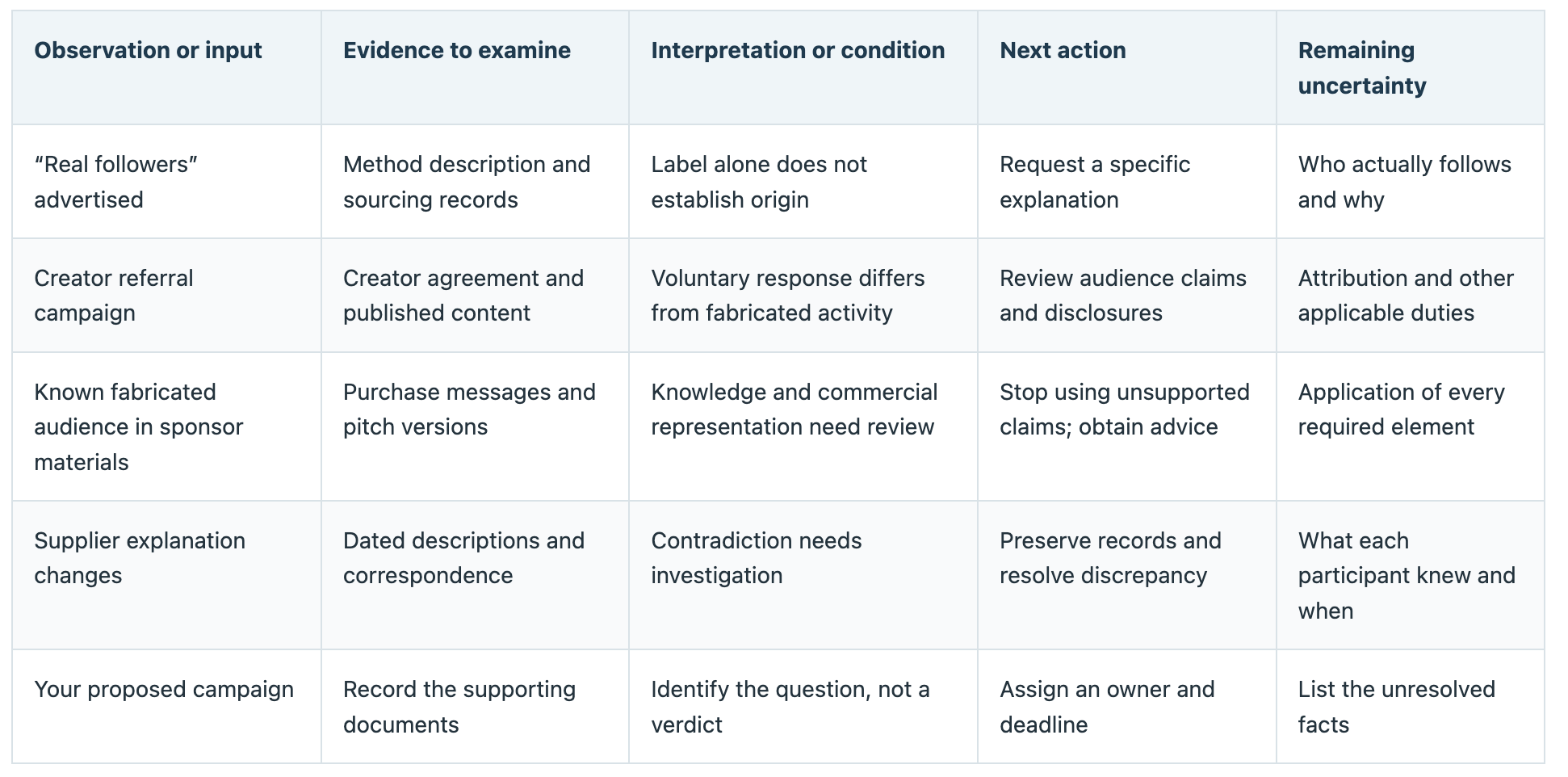
Apply the rule to agency claims and reporting
Do not represent purchased counts as genuine customer approval
A report should distinguish what happened from what the agency wants the result to mean. A visible count is not automatically evidence of satisfied customers, voluntary recommendations, qualified demand, or increased sales.
Consider a fictional monthly report showing an increase of 5,000 followers. The account team labels the chart “5,000 new brand advocates,” although it has only an order record and two screenshots. The label adds a claim about people’s attitudes that those documents do not establish.
A better review begins by identifying the metric, the observation period, the acquisition method, and the limits of the evidence. If the underlying activity may be fabricated, changing the chart’s wording is not a substitute for addressing that activity and any misleading public impression.
Before releasing a report, compare three layers:
- Supplier promise: What did the purchased service say it would provide?
- Observed result: What do the available records actually establish?
- Audience impression: What will a client, sponsor, or customer reasonably understand from the presentation?
Differences between those layers deserve attention. A supplier might promise a numerical increase while the agency sells an improvement in credibility. The client may then present that credibility as independent public approval. Each step adds a representation that needs its own basis.
Disclosure also has limits. Explaining that a creator was paid helps audiences understand a material relationship; it does not make fabricated accounts authentic. Do not treat an “advertisement” label, a private client acknowledgement, or a general disclaimer as a universal cure for conduct covered by Section 465.8.
This article does not certify any service offered by MoreThanPanel or another provider. Assess the specific method and proposed representation using the relevant evidence.
Retain provenance and the basis for marketing claims
Provenance means the documented origin and handling of the activity you report. The following records are practical recommendations for review, not a claim that Section 465.8 prescribes this exact recordkeeping system.
Keep the service description used at approval, the agreed scope, supplier correspondence, payment and order identifiers, relevant reporting exports, and copies of the claims ultimately published. Record dates and responsible people so that another reviewer can reconstruct the decision.
Preserve uncertainty as well as positive evidence. If a supplier cannot explain a method, write “method not established” rather than replacing the gap with a favorable assumption. If a screenshot shows a count, describe it as a count observation rather than a verification of every account behind it.
An annotated responsibility checklist can prevent these questions from being lost between teams: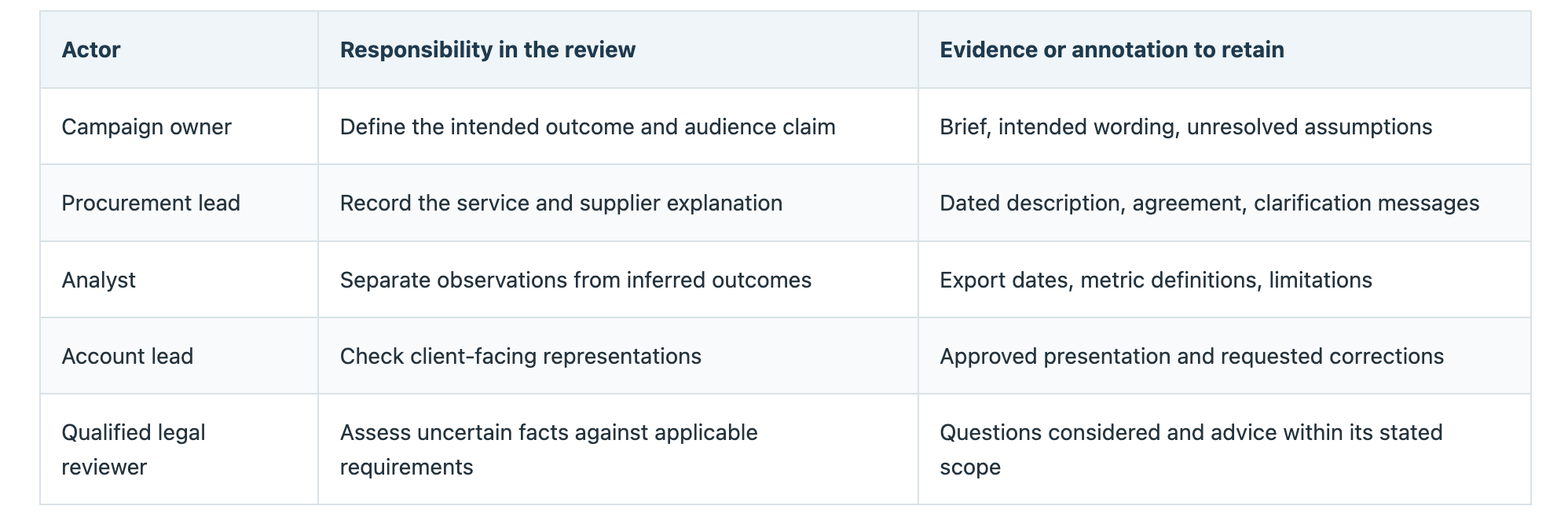
Treat this as an organizational tool. Assigning a responsibility does not transfer away another party’s legal obligations.
Keep a decision log alongside the evidence. For each proposed claim, record the exact wording, its supporting documents, the person responsible for checking it, and any condition that must be resolved before publication. This makes approval specific to a claim rather than a general endorsement of the supplier. Document the reason whenever a proposed claim is rejected.
For example, approving an invoice confirms a purchasing step. Approving a statement that an audience consists of interested customers requires different support. Teams should not allow the first approval to stand in for the second merely because both concern the same campaign.
After a material correction, identify where the earlier claim appeared: client decks, sales proposals, public pages, or scheduled posts. Ask the appropriate reviewer what should be corrected and how affected parties should be informed. Preserve the earlier version and the correction history where appropriate. These suggested controls support accurate communication; they do not establish compliance or replace advice on a particular incident.
If evidence suggests a supplier deliberately misrepresented its service, move into the separate task of identifying service scams and preserving evidence. A delayed order or poor campaign result alone does not establish deception.
Escalate uncertain use cases for qualified review
Check the current rule and enforcement guidance
Start with the current regulatory text, then consult the FTC’s explanations and relevant enforcement materials. The FTC’s final-rule resource provides the adoption materials; the eCFR provides the current codified provisions.
The sources for this article were checked on October 5, 2026. Recheck them when designing a campaign or revising a service, because an old summary should not substitute for current requirements.
For a productive legal review, prepare a short case file rather than asking only whether “buying followers is legal.” Include the proposed activity, participant roles, target audience, supplier statements, intended claims, and unresolved facts. State whether the activity is merely proposed, already ordered, or already reflected in public materials.
Useful questions for a reviewer include whether the indicators fit the definition, which provision concerns each participant, what evidence bears on knowledge, and how the commercial representation should be understood. Cross-border arrangements may require additional analysis; a company’s location alone does not answer every applicability question.
The FTC’s announcement of the final rule explains its civil-penalty enforcement purpose. Do not assume a particular transaction automatically produces a fixed fine. Enforcement consequences require their own legal analysis.
The rule also does not provide a private right of action, as the FTC’s questions and answers explain. Refunds, cancellation rights, contractual remedies, and payment disputes are separate questions. Keep those issues in the case file without assuming that this provision guarantees reimbursement.
Keep platform policies separate from legal analysis
Platform permission and legal analysis operate on different terms. A conclusion about one FTC provision does not establish that a social network permits the activity.
For example, YouTube’s fake engagement policy prohibits artificial increases in engagement metrics and explains that prohibited methods used by someone hired to promote a channel can affect that channel. Those platform rules must be considered independently of the FTC analysis.
Likewise, secure payment processing, responsive support, or delivery without a password does not resolve the fake-indicator question. Those features relate to other aspects of the transaction.
For the wider assessment, use our guide to SMM panel account, financial, and policy risks. It covers the surrounding decisions without replacing the specific rule analysis here.
Before approving a campaign, complete four statements: the activity we are obtaining is understood; the available evidence supports our description; our public and client-facing claims match that evidence; and unresolved legal or platform questions have a named reviewer. If any statement remains unsupported, keep that uncertainty visible and resolve it before relying on the proposed claim.