


How SMM panel costs are calculated

SMM panel costs can appear as $1, $6, or $20 for a listed service. SMM panel costs depend on more than the displayed service rate.
The displayed rate represents only one part of the calculation.
The final amount associated with an SMM panel order can also depend on:
the rate’s billing unit;
the quantity ordered;
minimum-order rules;
payment or funding charges;
currency conversion;
confirmed refunds or partial-order credits;
how much of a deposit remains unused.
This creates one important distinction: the amount you deposit, the amount an order consumes, and the effective cost of the result are three different numbers.
A $25 deposit does not make a $15 order cost $25. A $15 order also does not mean only $15 in cash was required to start when the account has a larger minimum deposit.
Separate three questions to compare SMM panel costs accurately:
What does the order itself cost?
How much cash must you commit to place it?
What quantity forms the denominator for the effective unit cost?
This guide explains these three questions with formulas and fictional examples. None of the example prices, fees, quantities, or retention figures represents a current MoreThanPanel offer or measured performance.
Read what an SMM panel is and how it works if you need the basic ordering model first. This guide focuses on calculating and interpreting SMM panel costs rather than ranking providers by price.
Start with the billing unit and service description
A listed price has no useful meaning until its denominator is clear.
A listing that shows $6 can represent:
$6 per 1,000 units;
$6 per 100 units;
$6 for a fixed package;
$6 for another predefined service configuration.
These prices are not interchangeable.
Identify exactly what the listed rate buys before making a cost comparison.
Record the service identifier together with the service name.
Two services can have nearly identical names while using different quantity limits, target requirements, refill conditions, delivery options, geographies, or other features. These differences determine whether the services are genuinely comparable.
Capture five details for each candidate service:
The listed rate and currency.
The quantity covered by that rate.
The minimum and maximum order quantities.
Any fixed package size or recurring arrangement.
The relevant conditions and the date you checked them.
MoreThanPanel’s API reference documents methods for retrieving the service catalog and information about orders, refills, cancellations, statuses, and balances. Service data returned through an Application Programming Interface (API) can support automated cost calculations. Treat the retrieved value as the rate applicable at the time of the lookup rather than a permanent price quote.
This distinction is important for spreadsheets, reseller software, and automated pricing tools.
The arithmetic can remain correct while the input becomes outdated if a supplier catalog changes after the service data was retrieved.
A lower displayed price does not automatically establish a lower comparable price.
Consider two fictional services:
Service A: $4 for 200 units
Service B: $6 per 1,000 units
Service A appears cheaper when comparing only $4 with $6.
Normalize both prices:
Service A: $4 ÷ 200 × 1,000 = $20 per 1,000 equivalent
Service B: $6 per 1,000
Service A has the lower displayed price but the higher normalized rate.
Comparable SMM panel costs begin with the denominator rather than the displayed dollar amount.
Calculate the base order charge
Use the stated rate basis
The base order charge measures the cost of the requested quantity under the stated rate.
Use this formula for a service priced proportionally by quantity:
Base order charge = listed rate × requested quantity ÷ units covered by the rate.
Consider a service priced at $6 per 1,000 units with a requested quantity of 2,500:
$6 × 2,500 ÷ 1,000 = $15
The base order charge is $15.
This calculation answers one specific question:
How much does the requested service quantity cost under the stated rate?
The base order charge does not establish:
how much money must be deposited;
whether a payment fee applies;
what currency conversion costs;
whether tax applies;
whether a later partial order changes the net charge.
Keep these cost stages separate.
The same formula works with another billing basis when the denominator changes with it.
Consider a rate of $2.50 per 100 units and a requested quantity of 400:
$2.50 × 400 ÷ 100 = $10
Do not divide every SMM panel rate by 1,000 automatically. A rate can use another billing basis even though “per 1,000” is common.
Check minimums, packages, and rounding
Mathematical availability and product availability are different.
Suppose the proportional formula calculates that 20 units cost $0.12.
There is no $0.12 purchase available when the service minimum is 100 units.
The service rules determine the smallest available order.
Fixed packages create the same distinction.
A $10 package containing 500 units does not automatically allow a 250-unit order for $5. The seller must explicitly permit prorating for that calculation to apply.
Rounding also matters in automated calculations.
Consider a raw formula result of:
$1.273846
A spreadsheet can preserve six decimal places while the panel ledger records fewer decimal places.
The difference can be minor for one order.
Repeated rounding differences can accumulate across thousands of reseller transactions.
Use this three-step workflow:
Preserve high precision in the calculation.
Record the actual amount deducted.
Reconcile the difference instead of assuming one side is incorrect.
Repeated or scheduled orders require another check.
The expected charge can be understated when a quantity field represents each run rather than the entire campaign and the wrong value is multiplied.
Determine whether the displayed quantity means:
quantity per run
or
total quantity across all runs.
Add fees without counting them twice
SMM panel costs become overstated when account-funding costs and individual order costs are combined incorrectly.
Suppose you deposit $100 and pay a $4 funding fee.
You then place 10 orders from that balance.
Charging the full $4 fee to every order converts one actual $4 fee into $40 of fictional costs.
Use this framework:
Adjusted order cost = base order charge + attributable additional costs − confirmed order credits
The important term is attributable.
Include a cost when you can explain why that portion belongs to the order or campaign being measured.
Possible attributable costs include:
payment-processing charges;
currency-conversion costs;
applicable taxes;
another documented transaction charge.
Do not add costs simply because they may exist for another payment method or another transaction.
Use only the charges that apply to the transaction being calculated.
Payment fees need an allocation method
Payment fees require a consistent allocation method when one deposit funds multiple orders.
Suppose one $100 deposit incurs a $4 fee and later funds several orders.
The correct allocation depends on the question being measured.
The full $4 fee belongs to the account-level analysis when you calculate the economics of the entire funded account.
The fee can be allocated proportionally when you calculate individual order economics.
For example, an order consuming $25 of the $100 deposit can receive this proportional allocation:
$4 × $25 ÷ $100 = $1 allocated funding fee
The adjusted order cost then includes the $1 allocated fee.
Another accounting method can assign the entire funding fee to one campaign when the deposit was made exclusively for that campaign.
Neither method is correct for every situation.
Consistency determines whether the resulting comparison is useful.
Do not:
allocate a fee proportionally to Service A;
assign the entire deposit fee to Service B;
compare both services as though the accounting basis were identical.
Document the allocation method before comparing SMM panel costs.
For separate questions about funding channels, settlement, and available protections, read SMM panel payment methods. Verify payment availability and fees for the specific account and transaction.
Currency conversion changes the comparison
Currency conversion changes the cost comparison when services use different currencies.
Consider one service priced at $10 and another priced at €9.
The two prices cannot be compared accurately until both use the same currency and a defined exchange rate.
Record four values:
The original currency.
The original charge.
The conversion rate or converted amount.
The date or transaction point used.
The amount recorded by your payment provider is generally more useful for retrospective cost analysis when the provider has already converted the transaction into your home currency. Using today’s exchange rate to reconstruct an older transaction can produce a different result.
Avoid counting currency-conversion costs twice.
Do not automatically add another estimated foreign exchange (FX) spread when the recorded converted amount already includes the payment provider’s exchange-rate spread. Add a separate FX fee only when one was actually charged.
This distinction becomes more important for reseller accounts that fund in one currency, maintain a panel balance in another currency, and invoice customers in a third currency.
Three currency events can then exist:
customer billing currency → business accounting currency → supplier balance currency
Record each currency event separately instead of combining them into one assumed exchange rate.
Taxes and invoice treatment depend on the actual transaction and applicable rules. Use billing records and qualified advice where appropriate rather than applying a generic tax percentage to every SMM panel order.
Work through an order and funding example
Consider a fictional account with no starting balance and no promotional credit.
The example service costs $6 per 1,000 units.
The buyer requests 2,500 units.
The panel requires a $25 deposit.
For this example only, the payment method charges 4% of the deposit + $0.40. The fee is added on top of the deposit.
Assume:
no currency conversion;
no tax;
no additional order fee.
The calculations are: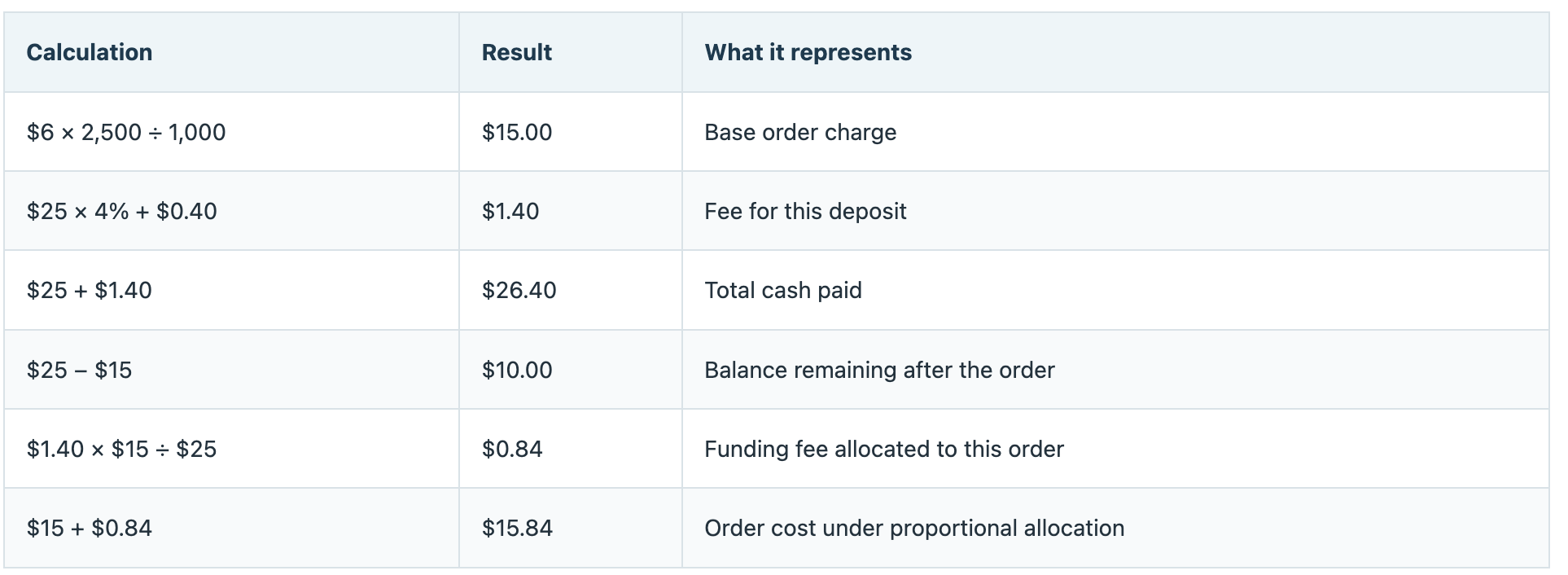
$26.40 — cash committed
This amount leaves the buyer’s external payment source during account funding.
$15 — panel balance consumed by the order
This amount is the service charge.
$15.84 — allocated economic cost of the order
This amount includes the proportional share of the funding fee under the selected accounting method.
These three figures answer different questions.
The remaining $10 balance is not another $10 expense to add to the $26.40. The $10 is part of the original funded amount that has not yet been consumed by an order.
The unallocated $0.56 of the funding fee also remains associated with the unused portion under this proportional method.
The remaining fee can be allocated later if the $10 balance funds another service.
A business-level analysis may instead need to evaluate whether the stranded balance represents an economic cost if the remaining balance is never used.
That analysis is different from treating the unused balance as part of the first order.
Use a three-ledger model:
Cash ledger: What left the bank, card, wallet, or payment account?
Panel ledger: What entered and left the SMM panel balance?
Order ledger: What costs and adjustments belong to the specific order?
Keeping the three ledgers separate prevents common SMM panel cost calculation errors.
When checking an actual provider after completing the calculation, review MoreThanPanel’s current offering and the relevant service details. Recalculate using the current terms instead of treating the fictional inputs above as a quotation.
Separate funding requirements from consumption
A deposit and an order are financially connected but represent different transactions.
A deposit transfers money into an account balance under the provider’s rules.
An order consumes part of that account balance.
Suppose you want to place a $3 order while the funding system requires a $30 deposit.
Two statements are simultaneously correct:
The order costs $3.
You need $30 in available cash to start.
Calling the order a “$30 service” misrepresents the service cost.
Calling the required cash commitment “$3” misrepresents the funding requirement.
This distinction matters when comparing SMM panels with different minimum-funding requirements.
Consider:
Panel A
Order cost: $4
Minimum funding required: $50
Panel B
Order cost: $5
Minimum funding required: $10
Panel A has the lower service cost.
Panel B has the lower initial cash requirement.
The preferable option depends on whether the remaining balance has a planned use.
A reseller planning hundreds of future orders may place little importance on the unused $46 in Panel A.
A one-time buyer can place much greater importance on the same unused balance.
Do not treat unused balance as automatically lost.
Do not treat unused panel balance as equivalent to unrestricted money held in a bank account either.
For MoreThanPanel specifically, its current refund policy states that deposited balance does not expire but deposits are not refundable to the original payment source. This distinction shows why available panel balance and recoverable external cash are different assets.
Promotional credit introduces another category.
A $10 promotional balance is not automatically equal to $10 deposited in cash when the two balances have different:
expiry rules;
withdrawal rules;
service eligibility;
account requirements.
For that specific decision, compare free SMM trials and funded accounts. A trial can answer a limited evaluation question, but a trial does not remove the need to understand funding requirements or establish future performance.
Reconcile partial orders, credits, and refills
The initial order charge does not always remain the final net cost.
Suppose a service cannot complete the full requested quantity.
The provider’s terms can determine whether the remaining amount is:
credited to the internal balance;
refunded through another method;
replaced;
left pending during a support investigation.
Do not change the recorded cost until the remedy appears in the relevant record.
Capture six details for every adjustment:
Original order charge.
Delivered quantity.
Adjustment amount.
Adjustment date.
Adjustment reason.
Destination of the money or credit.
A balance credit and a cash refund are different financial outcomes.
A $5 credit returned to the panel balance can reduce the net panel-level service expenditure by $5.
The same $5 has not returned to the bank account unless a cash refund is actually processed.
This distinction affects cash-flow analysis and client reporting.
MoreThanPanel’s published refund policy currently states that canceled orders receive a 100% return of the relevant order funds to MoreThanPanel balance. The policy also states that partial orders receive a proportional balance refund for the undelivered portion and that deposits are not refundable to the original payment source. These are three different financial events and need separate records.
Confirm the actual order history before applying the policy to a completed calculation.
A policy describes the applicable process.
A policy does not prove that a particular adjustment has already been posted.
A separate fictional partial-order example
Consider an order originally priced at $12 for 1,000 units.
The records later show:
750 units delivered
$3 confirmed order credit
$1 separate attributable fee that was not refunded
The original service charge is:
$12
The net service charge after the confirmed credit is:
$12 − $3 = $9 net service charge
Add the retained $1 fee:
$9 + $1 = $10 adjusted attributable cost
Now calculate the cost per recorded delivered unit:
$10 ÷ 750 = approximately $0.01333 per unit
Normalize the result per 1,000 units:
$0.01333 × 1,000 = approximately $13.33 per 1,000 delivered units
This example demonstrates one important result.
A partial refund can reduce the total amount paid while the effective unit cost still increases above the original headline rate.
The effective unit cost increases because the denominator also changes.
The original service appears as:
$12 per 1,000 requested units
After the partial delivery and retained fee, the recorded economics become:
$13.33 per 1,000 delivered-unit equivalent
The refund amount alone therefore does not determine whether the final transaction became cheaper on a unit basis.
Do not deduct an expected $3 credit before the credit appears in the ledger.
A pending refund represents a possible future adjustment.
A confirmed ledger entry provides a recorded amount.
Use the confirmed amount for final calculations.
A refill represents another type of adjustment.
A refill normally adds replacement delivery rather than reducing the financial charge.
Do not count replacement units simultaneously as:
newly purchased volume
and
the original delivery remaining intact.
Counting both would overstate the result.
Calculate unit costs with the right denominator
Requested, delivered, and retained units answer different questions
Requested, delivered, and retained quantities produce different unit-cost calculations.
The denominator is therefore as important as the cost itself.
Cost per requested unit answers:
What did I pay relative to the quantity I ordered?
Cost per delivered unit answers:
What did I pay relative to the quantity supported as delivered?
Cost per retained unit answers:
What attributable cost remains when compared with a quantity supported as retained at a defined observation point?
Use this formula for a defined observation period:
Cost per retained unit = adjusted attributable cost ÷ supported retained units
Then calculate:
Cost per retained 1,000 = cost per retained unit × 1,000
Cost per retained unit can provide useful information. It also creates a high risk of incorrect attribution.
Suppose an account begins with 10,000 followers, receives a 1,000-follower order, and shows 10,900 followers 30 days later.
The account shows an observed net increase of 900 followers.
The total count alone does not establish that 900 followers from the order remain.
Five other events can affect the count during the 30-day period:
Genuine followers can arrive.
Existing followers can leave.
Accounts can be deleted.
Other campaigns can run.
The platform can adjust the metric.
The observed net account increase is 900.
The retained quantity attributable specifically to the order can be different.
Report the supported observation when attribution is unavailable:
Observed net change: +900
and record:
Supported retained quantity: unavailable
Do not create a precise retained quantity without supporting evidence.
A zero supported retained quantity also prevents the cost-per-retained-unit formula from producing a meaningful finite result.
The correct interpretation is not “$0 per retained unit.”
The denominator required for the metric no longer exists.
Compare equivalent observations
Consider the following fictional dataset.
Both options request 1,000 units.
Both options use the same observation period.
Assume only for this example that retained quantities can be attributed reliably.
Option A appears cheaper at checkout:
$11 versus $13
Option B becomes slightly cheaper after normalizing by the assumed retained quantity:
$13.68 versus $13.75 per retained 1,000 equivalent
This result does not automatically make Option B the better purchase.
The difference is only $0.07 per retained 1,000 equivalent in this fictional example.
Do not describe Option B as meaningfully superior when the measurement uncertainty exceeds the $0.07 difference.
Include five factors in the comparison:
Observation window.
Attribution quality.
Calculation method.
Rounding rule.
Measurement uncertainty.
Use this principle:
Confidence in a small normalized cost difference decreases as uncertainty in the denominator increases.
A large price difference can therefore be meaningful while a difference of only a few cents can fall within measurement uncertainty.
Keep service cost separate from business return
Service cost measures what the service costs.
Business return measures what the purchase produces for the business.
A low cost per delivered unit does not establish:
qualified traffic;
customer interest;
sales;
retention;
meaningful audience interaction.
A revenue increase after an order also does not prove that the order caused the revenue increase.
Consider a business that performs five activities during the same week:
Buys an SMM service.
Launches a new product.
Increases advertising spend.
Receives a mention from a creator.
Sends an email campaign.
Revenue then increases by 15%.
Assigning the complete 15% increase to the SMM order ignores four other plausible causes.
Keep three metrics separate:
cost per delivered unit
is different from:
customer acquisition cost
and neither is automatically:
return on investment.
Agencies need another distinction.
Suppose the supplier charges an agency $10.
The agency charges its client $40.
The $40 client price does not mean the underlying SMM panel service costs $40. The difference also does not automatically represent $30 of pure margin.
The client fee can include:
campaign preparation;
service selection;
reporting;
monitoring;
account management;
support;
other agreed work.
Keep supplier cost and client billing separate so neither figure is misrepresented.
Apply the same distinction to prepaid exposure.
Money held in a supplier balance creates a cash-management consideration.
The cost of one completed order creates a service-cost consideration.
Prepaid exposure and service cost can affect each other without becoming the same metric.
Use a short calculation checklist
Use this eight-step checklist before relying on an SMM panel cost comparison:
Confirm the service, currency, rate basis, and quantity limits.
Confirm that the requested quantity matches the formula and actual purchase structure.
Separate funding fees from order fees and count each charge once.
Record currency-conversion and tax assumptions instead of guessing them.
Show deposits, consumed balance, and unused credit separately.
Reduce recorded order cost only with confirmed financial adjustments.
Define every unit-cost denominator and its supporting evidence.
Check current prices and conditions before committing funds.
Use one additional test:
Can another person reproduce the number from your records?
A spreadsheet showing an order cost of $13.72 has limited operational value when nobody can identify:
which rate was used;
which fee was allocated;
which currency rate applied;
whether a refund was deducted;
what quantity formed the denominator.
The arithmetic can be correct while the record remains operationally unusable.
Keep the original quote or service description with the final order record.
Identify the reason when an estimated cost differs from the recorded charge before building another comparison on the same assumption.
Check whether the recorded charge already includes adjustments
Recorded charges need to be checked for previous adjustments before another credit is deducted.
Consider:
Original order charge: $12
Confirmed credit: $3
The resulting net charge is:
$12 − $3 = $9
Now suppose a later report already shows:
Adjusted order charge: $9
Subtracting the $3 credit again creates:
$9 − $3 = $6
The $6 figure contains a fictional second refund.
Preserve the transaction chain:
Original charge → adjustment → resulting net amount
Do not overwrite every earlier figure with the newest number.
The complete transaction chain makes reconciliation and auditing easier.
Apply the same principle to changes in catalog prices.
A service can cost $1.20 today after costing $1.00 when yesterday’s order was placed. Today’s catalog price does not rewrite the recorded cost of yesterday’s transaction.
Use the order record applicable to the purchase.
Consistency matters more than complexity in multi-order comparisons.
Apply the same fee policy to comparable orders if payment fees are included for one order.
Do not directly compare seven-day retention for one service with 30-day retention for another service without identifying the different observation windows.
Keep pending adjustments separate from confirmed adjustments.
Record what changed when the analysis is revised later.
These records convert a spreadsheet from a collection of numbers into a reconciliation trail.
Common questions about SMM panel costs
Does a rate per 1,000 require ordering 1,000 units?
No. A rate per 1,000 does not necessarily require an order of 1,000 units.
The rate basis defines how the price is expressed.
The minimum order defines the smallest quantity available for purchase.
A service can therefore show a price of “$5 per 1,000” while allowing an order of 100 units.
The proportional calculation is:
$5 × 100 ÷ 1,000 = $0.50
The actual service rules still determine whether the 100-unit quantity is available.
Check both the rate basis and minimum-order field.
Is a higher minimum deposit an extra service charge?
No. A higher minimum deposit is not automatically an extra service charge.
A minimum deposit increases the cash required to fund the account.
The deposit requirement does not automatically increase the underlying price of an individual service.
Consider:
Minimum funding requirement: $20
Order consumed: $3
Remaining balance: $17
The order remains a $3 order even though the account required $20 of funding.
The funding requirement can still affect a one-time buyer significantly when the remaining $17 cannot be returned to the original payment method.
MoreThanPanel’s current policy, for example, states that deposited funds remain available in account balance but are not refundable to their original payment source.
Keep these two amounts separate:
service cost
and
cash committed to the provider.
Can a refill make the effective cost lower?
A refill can lower the effective cost under specific measurement methods, but it does not reduce the original purchase price automatically.
Suppose a $10 order initially delivers 1,000 units.
Later, 200 units are lost and an eligible refill replaces them without another charge.
The financial cost remains $10.
The refill changes the delivery or retention history rather than the original purchase price.
Replacement delivery can affect the denominator when calculating cost per supported retained unit at a later observation point.
A refill does not automatically:
create cash back;
prove the original cohort remained;
prove genuine audience interest;
guarantee indefinite retention.
Record the original delivery, drops, refill quantity, and final observation separately.
What number should I use to compare two services?
Use several cost figures when the decision involves different financial questions. There is no single best number for every SMM panel comparison.
Start with:
normalized base price
to compare the stated service rates.
Then calculate:
adjusted attributable cost
when documented fees and confirmed credits affect the transaction.
Keep:
cash required to fund the account
visible when the initial financial commitment matters.
Use:
cost per delivered unit
when supported fulfillment differs between services.
Use:
cost per retained unit
only when the retained quantity can be supported through a defined measurement method.
A reliable SMM panel comparison can therefore show several figures side by side instead of forcing every factor into one “cheapest” number.
The central principle of SMM panel cost analysis is clear:
the displayed price, the cash committed, the balance consumed, and the effective cost of the result can all be different. Accurate calculations keep these differences separate and visible.