


Free SMM Trials versus Funded Accounts: Costs and Limitations

A $2 order can require $21 to leave your bank account. A $5 trial credit can also fail to cover the service you want to evaluate. Both situations are possible when deposit requirements, payment fees, and minimum order quantities affect the final cost.
Free SMM trials versus funded accounts differ in three main ways: what you can evaluate, how much money you must commit, and what happens to the remaining balance when you stop.
A free SMM trial provides limited access or promotional credit under specific offer conditions. A funded account holds prepaid money for placing orders. Neither a free SMM trial nor a funded account proves service quality or guarantees future results.
The calculations below are hypothetical examples rather than reported test results or MoreThanPanel prices. Provider-specific statements reflect the published pages reviewed on 10 October 2026.
Identify what the free offer actually includes
Free registration is different from a free service
Free registration provides access to an account or dashboard in some cases. Free registration does not necessarily include order credit, service delivery, or access to every feature.
Identify the actual benefit first. The benefit can be a demonstration, a fixed service sample, a temporary feature, or a spendable balance. Then identify the activation requirement. Registration, eligibility approval, and a qualifying deposit represent different conditions.
A demonstration can show how the ordering interface works without requiring an order. A live trial can send activity to an actual profile. Establish which type of experience you are using before entering a target URL.
The distinction matters because “no payment required” describes only the charge. The phrase does not establish whether an action affects a live account.
Promotional credit is different from deposited money
Promotional credit provides practical value when you can use it for a relevant service. Service exclusions, expiry dates, and minimum order quantities can affect its usefulness more than the advertised credit amount.
Consider a fictional $5 credit restricted to a service priced at $12 per 1,000 units with a minimum order of 500 units. The smallest eligible order costs:
$12 × 500 ÷ 1,000 = $6.
The $5 credit cannot cover the $6 minimum order alone. You still need to make a funding decision if the provider allows promotional credit and deposited funds to be combined. Adding deposited money may not resolve the restriction if the provider prohibits combining the two balances.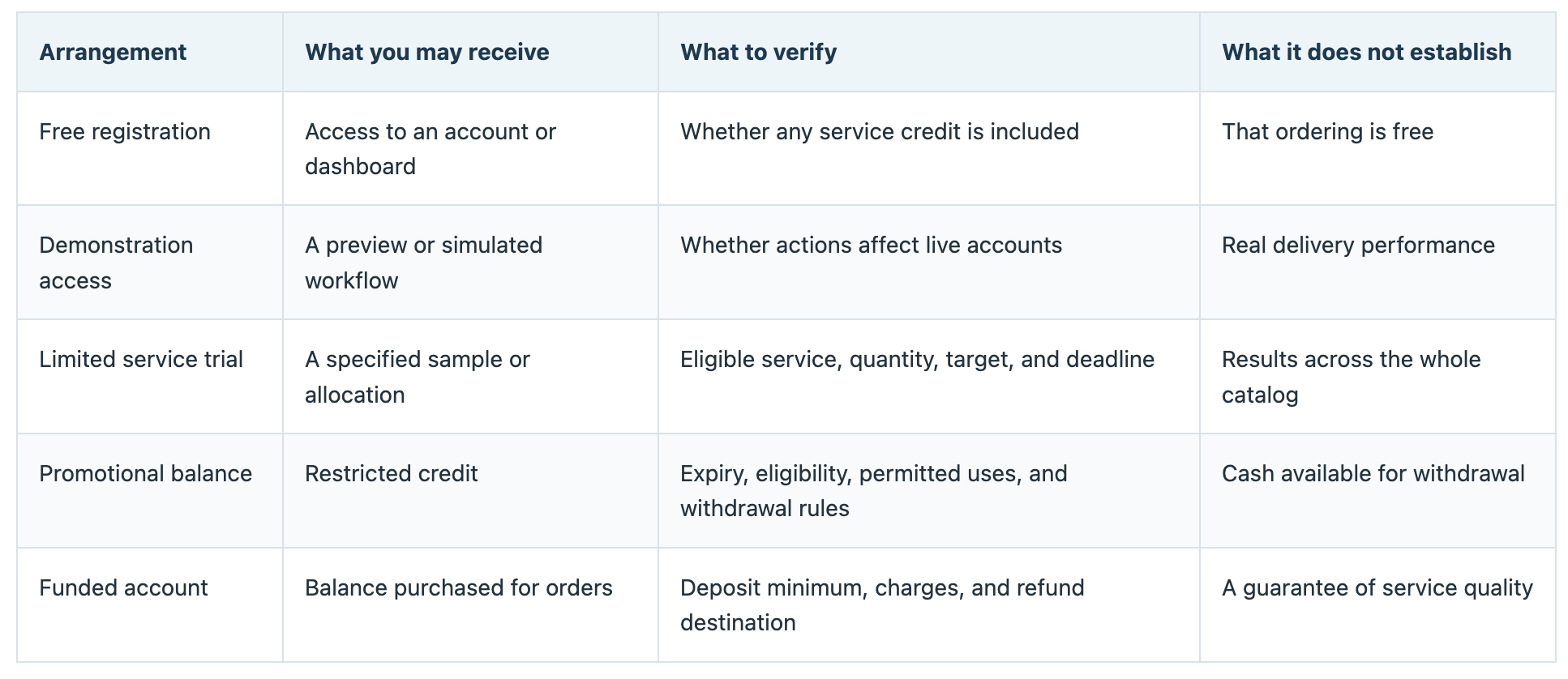
Deposited funds and promotional credit need separate records even when the dashboard displays one combined balance. Check which balance is used first. Check whether either balance expires. Also check what happens to each balance when an order is canceled.
A displayed balance shows the amount of credit held in the account. The conditions attached to that balance determine how much of the credit is practically usable.
Read trial restrictions before evaluating the result
Check eligibility, service scope, and timing
Match the trial offer to the service you need to assess. Record the service ID, service description, minimum quantity, and refill conditions before submitting an order.
Two services labeled “followers” can have different delivery descriptions and remedy terms. A trial covering one follower service does not automatically provide evidence about another follower service.
Check whether the trial uses the same service ID and conditions as the intended paid purchase. The trial can still help you evaluate the interface if that connection cannot be established, but it provides less evidence about the service you intend to purchase.
Separate timing into three questions. First, determine when you must claim the offer. Secondly, determine when you must spend the credit. Thirdly, determine how long you need to observe the result.
Credit that expires tomorrow can still permit an order today. An expiry date tomorrow does not make tomorrow a sufficient endpoint for evaluating retention.
Save the offer and written clarification with a date. A dated record provides a concrete reference when a promotion or service description changes.
Check whether a payment or renewal follows
Identify the action that can trigger the next charge. A manual deposit or enabled automatic top-up can trigger another payment with a prepaid account. The end of an introductory period can trigger another payment with a subscription.
A saved payment method does not establish which payment model applies.
For subscriptions, the FTC’s guidance on free trials and auto-renewals recommends checking the conditions, recording the cancellation deadline, and monitoring account statements. Record the renewal price and cancellation method before accepting the offer. Keep the cancellation confirmation after canceling.
For prepaid funding, check the top-up settings and unused-balance terms instead. Include the required deposit in the evaluation budget if a deposit is necessary to unlock the promotion, even when the sample itself has no charge.
Compare cash committed with the cost of one order
The advertised order price shows how much account balance an order consumes. The advertised order price does not necessarily show how much cash you must commit to start using the account.
Keep four amounts separate.
Cash paid is the amount leaving your payment account, including separately charged fees. Balance credited is the amount added to the panel, with promotional funds recorded separately. Order charge is the amount deducted for the selected order. Remaining balance is the account credit held after the order.
Check where each fee applies. A fee added at checkout increases the total cash paid. A fee deducted from the deposit reduces the credited balance. Currency conversion can create another difference between the payment receipt and the dashboard balance.
For a broader pricing explanation, read how SMM panel costs are calculated. For this decision, compare the actual checkout total with the amount of cash you are prepared to commit.
An illustrative funding comparison
Consider a fictional provider that requires a $20 deposit, adds a $1 payment fee, and credits $20 to the account. The first order costs $2.
You pay $21. The order deducts $2 from the account balance. The funded account then holds $18.
The reconciliation is:
$21 paid = $1 fee + $2 order + $18 remaining credit.
Adding the remaining $18 to the original $21 payment counts the same money twice.
Now consider another fictional offer. The offer provides $5 of credited balance, charges no payment fee, and deducts $3 for an otherwise comparable order. The order costs more, but only $5 leaves your payment account and $2 remains afterward.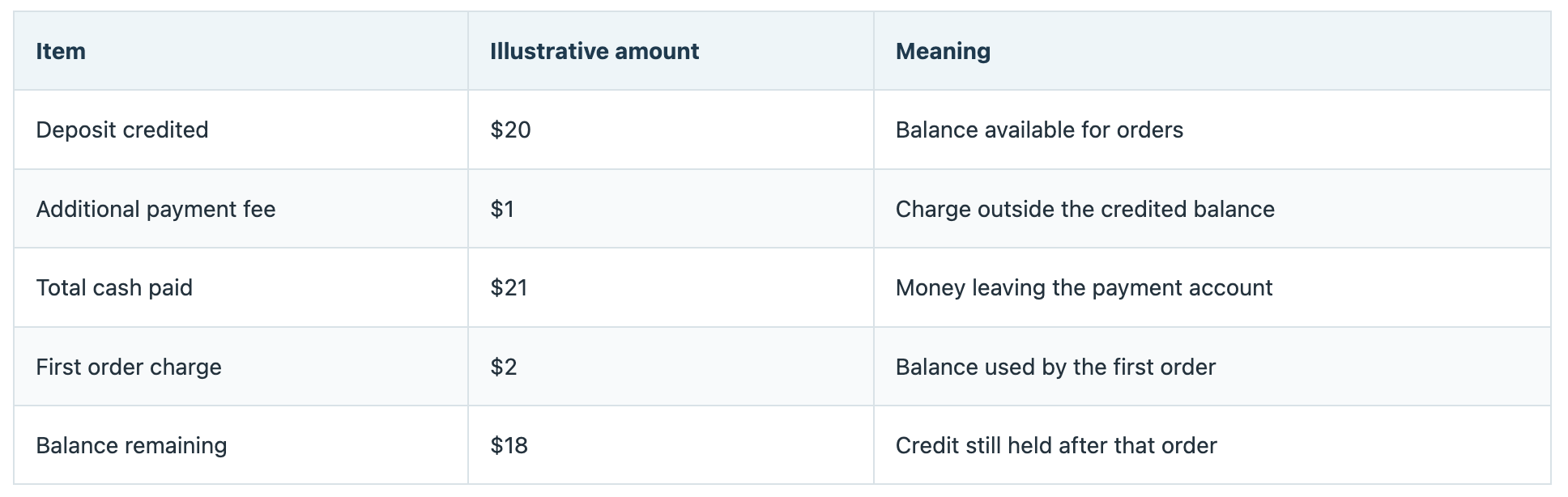
The smaller funding requirement can matter more than saving $1 on delivery during a one-off evaluation.
Neither remaining balance automatically represents a loss. The value of a remaining balance depends on whether you have an appropriate future use for it and whether the applicable terms allow recovery. These examples illustrate the calculation rather than MoreThanPanel’s rates, fees, or deposit requirements.
Include time and unused credit in the decision
A no-charge trial can still consume several hours through account setup, approval requests, unclear documentation, and support exchanges.
Estimate the required time separately from the required cash. Separating time from cash helps compare evaluation methods without treating one hour of staff time as another account deposit.
Give unused credit a realistic role in the decision. The remaining balance can provide value when planned future orders will use it. A large prepaid balance provides less flexibility than keeping the same money in your bank account when you are evaluating the panel once and have no further use for it.
Set a stopping point before starting the evaluation. An interface review, for example, can end after confirming that service descriptions and order records contain the information your team requires. Additional delivery does not improve the interface assessment after that question is answered.
Use one final check. Ask whether you would want the next order with a zero remaining balance. Spending money only to use the remaining credit is unlikely to improve the evaluation when the answer is no.
Understand what happens to unused funds and failed orders
A balance refund is different from a cash refund
A balance refund returns value to the panel account. A cash refund returns money to the original payment source. These two refund outcomes are different.
An order can be reversed inside the dashboard while the original payment remains with the provider.
Using the first example above, a full $2 order refund to panel balance restores the account balance from $18 to $20. Your payment account remains down $21. Recovering the $1 payment fee is a separate question.
Also distinguish three order outcomes: an order canceled before delivery, a partly fulfilled order, and a completed order with disappointing results. A provider can apply different remedies to each outcome.
A refill supplies additional activity under stated conditions. A refill does not return money and does not establish that the original delivery created business value.
Ask where an order reversal goes when promotional and deposited funds coexist. Restored promotional credit can produce a different practical result from restored deposited funds because promotional credit may contain additional restrictions.
Read the provider’s current terms
MoreThanPanel’s published refund policy, reviewed on 10 October 2026 and labeled updated August 2026, describes test balances for verified resellers as non-withdrawable. MoreThanPanel’s published refund policy states that deposits are not refunded to the original payment source and do not expire.
The same refund policy describes canceled-order refunds and proportional refunds for unfulfilled portions of partial orders as account credits. Its two-refill refund promise also returns funds to account balance, with refill exclusions stated elsewhere on the page. Read these conditions together before relying on the headline guarantee.
These statements describe the provider’s published terms. They do not represent independently verified performance results or a determination of your legal rights. Confirm eligibility for a specific offer or remedy for the account and service involved.
MoreThanPanel’s service overview provides a starting point for reviewing the provider. Use the specific service description and applicable terms to determine what the proposed transaction includes.
What a limited trial can help you observe
A limited SMM trial can answer a specific question defined before the trial starts. Examples include whether you can locate service restrictions, whether the order record contains the required information, and whether support explains a specific billing condition clearly.
Keep three types of evidence separate. First, record what the panel reports. Secondly, record what the destination platform displays. Thirdly, record what your business measures. An order status, a visible count, and a sale represent three different observations.
For a live order, record the service ID, quantity, target, submission time, completion time, and platform count at every observation point. Record other campaigns running during the same period. A change in the total can otherwise be incorrectly attributed to one order.
For example, YouTube’s explanation of metric verification states that counts can be slowed, frozen, or adjusted while activity is verified. Realtime estimates can also differ from the watch page. One screenshot therefore cannot establish both delivery and retention.
Write each conclusion at the level supported by the evidence. “Support explained the refund destination in this exchange” is a specific conclusion. “The provider is reliable” requires substantially broader evidence.
Technical access does not always mean simulated activity
Technical access does not always mean simulated activity. A “test” can describe your evaluation purpose rather than the technical environment. A test order can still spend account balance and send activity to a live target.
The MoreThanPanel API documentation distinguishes reading services, statuses, and balances from creating orders. MoreThanPanel’s FAQ also states that there is no separate sandbox. The API documentation further describes validation errors returned inside an HTTP 200 response. A successful network response alone is therefore insufficient for an integration review because the response body also matters.
Documented examples and locally simulated responses can help verify how your software handles specific outcomes. These methods evaluate your software’s behavior rather than live fulfillment. Authorized read operations can answer additional questions without creating an order.
Confirm the target owner’s permission and applicable platform rules before proceeding when an unresolved question requires live activity. Free promotional credit changes who pays for an order. Free promotional credit does not make the order simulated.
What a trial cannot establish
One successful sample does not predict every future order
One successful trial cannot predict every future order. A trial observes one service, one target, and one period. Changing the quantity, switching service IDs, or placing an order later changes the evaluation conditions. Repeating the same order also cannot guarantee an identical result.
A sample selected by the seller can also differ from the service selected for your own requirements. A smooth trial experience provides limited evidence about your intended product when the promotion covers a different service.
A precise evaluation note can state: “Sample completed; larger-volume delivery, later retention, and refund handling were not observed.”
Unanswered questions do not automatically justify additional spending. Documentation can resolve some questions. Other unresolved questions can remain reasons to defer the purchase.
Delivery does not prove safety, authenticity, or sales
Delivery does not prove safety, authenticity, or sales. A rising count establishes that a displayed metric changed. A rising count does not independently establish that an interested audience formed or that the activity complies with platform rules.
YouTube’s fake engagement policy prohibits artificial increases in engagement metrics and warns that actions taken by a hired promoter can affect the channel. The stated consequences include content removal or channel takedown. The policy provides no free-trial exemption.
A service that requires only a public URL avoids the need to share your password. A public-URL requirement does not establish how the activity is generated.
A sales increase during the same week also cannot independently attribute revenue to the order. Advertising, newly published content, seasonal demand, and existing customers can contribute to the same sales increase.
Evaluate each claimed outcome directly. Order completion requires order evidence. Audience quality requires relevant audience evidence. Commercial results require appropriate business measurement. One successful transaction cannot establish all three outcomes.
Choose an evaluation route that fits the question
Choose an evaluation route based on the uncertainty you need to resolve. Three fictional situations illustrate the difference.
A buyer wants to understand the dashboard. Documentation or a demonstration can answer the question. Live delivery adds little when the main uncertainty is where to locate an order record.
An agency needs to evaluate a particular service. The agency first checks whether the promotional allocation covers the exact service and its minimum quantity. A larger promotional credit restricted to a different product does not answer the original question.
A reseller needs to inspect integration behavior. Documented examples, local simulations, and authorized read operations can help evaluate response handling. A live order answers a different question and requires a separate decision.
Before proceeding, record five items: the unresolved question, the relevant offer restrictions, the total cash requirement, what happens to unused funds, and what will remain unknown after the evaluation.
The record can remain brief. For example: “We need to inspect order-status fields. Documentation and an authorized read can answer this. No deposit is currently needed. Delivery performance will remain untested.”
Another record can state: “The trial excludes the service we need. Its advertised credit does not help this evaluation. We will review the paid service’s conditions before deciding whether to fund the account.”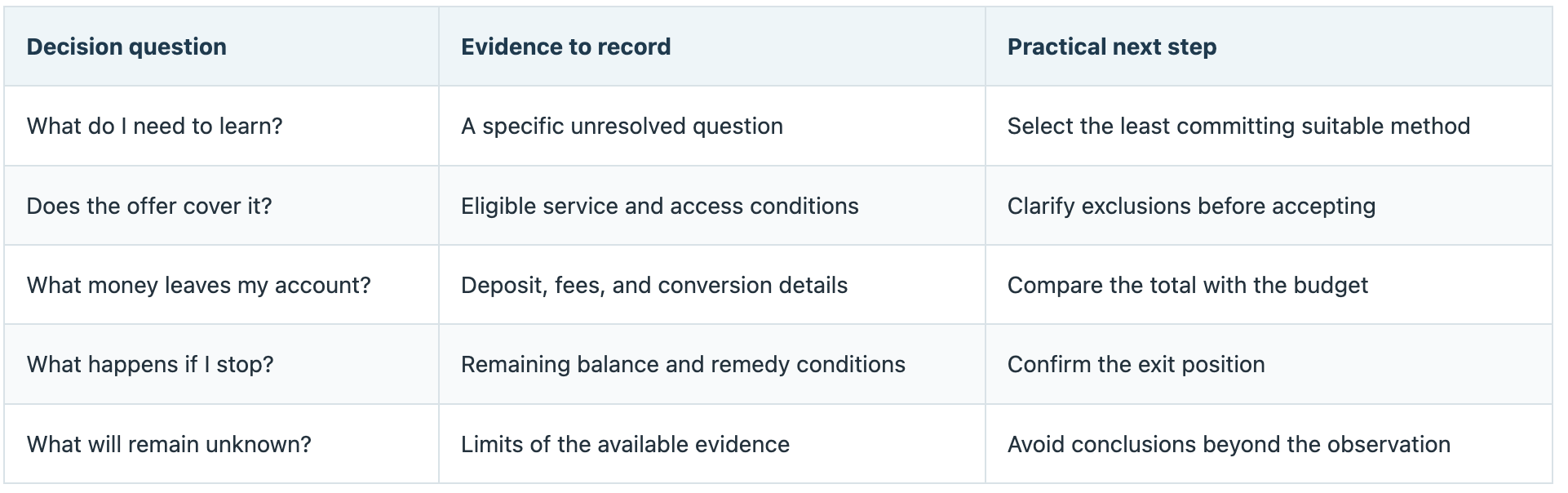
A useful evaluation can end without a deposit. A useful evaluation can also end with an informed purchase. The value of the evaluation comes from resolving a relevant uncertainty within an acceptable financial and operational commitment.
Common questions about trials and funded accounts
Is a free account the same as a free trial?
No. A free account and a free trial are not the same. Free registration can provide dashboard access without promotional credit or service delivery. Identify the specific trial benefit and the conditions required to activate it.
Is a paid account automatically more reliable?
No. A funded account is not automatically more reliable. Funding provides spending capacity. Funding does not independently verify service quality, support performance, or compliance with platform rules.
Can promotional credit be withdrawn?
Promotional credit can be withdrawn only when the offer explicitly permits withdrawal. Treat promotional credit as restricted spending capacity until its withdrawal, expiry, and usage conditions are clear.
Should I deposit more to receive a larger bonus?
Deposit more only when the additional balance matches planned and eligible spending. Calculate the bonus against the amount you already intend to use.
Consider a fictional offer that provides a $10 bonus after a $100 deposit. The funded account then contains $110. The $10 bonus represents about 9.1% of the $110 service value before fees when you use the entire balance on otherwise planned services.
The same promotion requires $100 upfront when you only need a $10 order. Most of the account balance can therefore remain unused. A larger displayed balance provides value only when the offer conditions match your actual spending needs.
When is a trial worth considering?
A trial is worth considering when it answers a relevant question, covers the required service or feature, and has acceptable conditions.
Check the smallest usable order, the total cash requirement, and the financial position you will have when the evaluation ends. These conditions determine the usefulness of free SMM trials more reliably than the word “free.”